
John Henry Barrows: Producing the First Parliament of Religions
Marcus Braybrooke - TIO Correspondent Posted on
Sunday, July 15, 2012 at 11:00AM Key Figures in Interfaith History
John Henry Barrows was the architect of the 1893 Parliament of Religions. Charles Carroll Bonney has been properly credited for coming up with the idea of a World Parliament of Religions. It was Bonney’s notion that the World Fair in Chicago and its great exhibits should be accompanied by a series of “congresses” or parliaments to provide a forum for discussing the state of anthropology, art, commerce and finance, education, labor, literature, medicine, philosophy, temperance, and religion. The most important congresses to Bonney were about religion. He, therefore, established a committee to organise them and appointed Rev. Dr. John Henry Barrows the chair.
John Henry Barrows
Barrows, born in 1847, was pastor of the First Presbyterian Church in Chicago. He had studied at Yale, at Union Theological (NY) and Andover Newton seminaries, and served congregations in Kansas, Massachusetts, and Paris. Rather than trying to describe the Parliament itself, this essay briefly summarizes Barrow’s contribution and theological stance.
Rev. Barrows, known as a powerful preacher, was clearly a tireless worker. Besides the World Parliament, his Committee organised 45 denominational congresses. In preparation for the Parliament of Religions, some ten thousand personal letters – not to mention forty thousand documents – were sent to the far corners of the world inviting support. “We affectionately invite the representatives of all faiths,” the letter said, “to aid us in presenting to the world, at the Exposition of 1893, the religious harmonies and unities of humanity, and also in showing forth the moral and spiritual agencies which are at the root of human progress.”
Then came the suspense of waiting for replies– it was long before the days of email. The response was mixed. Dharmapala of the Maha-Bodhi Society in Ceylon, now Sri Lanka, hailed the event as repeating the congress convened two thousand years ago by the Buddhist Emperor Ashoka. The Archbishop of Canterbury, E. W. Benson, sent a blunt refusal because “Christianity was the one religion.” The Catholic Archbishop of Ireland promised his “active co-operation.” Eventually the Advisory Councillors numbered over three thousand.
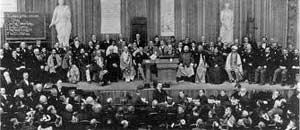
Dr. Barrows moderated most of the Parliament’s sessions.
Many could not make the journey to Chicago, so the actual Parliament was less representative than Barrows hoped, but no organizer of a conference can compel attendance. Greeting the thousands who were able to attend was an exciting moment. “When, a few days ago, I met for the first time the delegates who have come to us from Japan, and shortly after the delegates who have come to us from India, I felt that the arms of human brotherhood had reached almost around the globe.” Names on paper had become friends.
Barrows’ own church expressed strong disapproval of the Parliament. This may explain why his address at the opening session was rather defensive. He claimed that the Parliament would be a “blessing to many Christians.” Learning “what God has wrought through Buddha and Zoroaster,” he said, “in no way discredited the claims of Christianity.” Yet he ended his record of the Parliament by affirming that “there is no teacher to be compared with Christ” and that no other teachings “bring God so near to man as he is brought by Jesus’ message of the Fatherhood of God and the Brotherhood of Man.” His thinking reflects the evolutionary mood of the time, mirroring the World Fair’s celebration of humankind’s material progress.
In the same way Christianity, for Barrows, represented the highest stage ofhumankind’s religious evolution – “the great quickener of humanity” – but that evolution was not complete and would be enriched by the wisdom of the East. “Human progress,” he said, “would objectively reach its culmination through Christianity. As the apex of all religions, Christianity can influence other religions meaningfully, but not vice versa.”As Joseph Kitagawa said, “Barrows did not see any fundamental tension between being both a seeker of universal religious truth and a Christian.”
Barrow’s views diverged sharply from those of Jenkin Lloyd Jones, who was secretary of the committee planning the Parliament. Jones, a Unitarian minister, looked forward to a “universal religion dedicated to the inquiring spirit of progress, to the helpful service of love.” He criticised Barrows’ record of the Parliament as being too “Christo-centric” instead of “homo-centric.”
Many other theological positions on the relation of religions were reflected at the Parliament, but there was agreement that the coming together of religions around the Golden Rule was essential for a new age of peace and prosperity. “How can we make this suffering and needy world less a home of grief and strife and far more a commonwealth of love, a kingdom of heaven? How can we abridge the chasms of altercation which have kept good men from co-operating?”
All too soon after the Parliament, Barrows was reminded of grief. Two days before the end of the World Fair, the Mayor of Chicago was assassinated, and three months later, the “White City,” site of the Fair, was destroyed by fire. As he completed the 1,600 page record of the Parliament – two months after it ended! – his thirteen-year-old, eldest son, injured in football, died at home of septic peritonitis.
John Barrows died nine years later, in 1902, not before he had travelled to Asia, but before the grief and strife of the twentieth century would have shattered his hope that humanity was steadily journeying “along the pathway toward the spiritual Millennium.”
Reader Comments (3)
Thank you, Marcus, for this history about Rev. Barrows and the first Parliament of the World's Religions in 1893. As I travel around the U.S. and world with our interfaith documentaries, I am always surprised at how many people have not heard about the Parliament and its history. For many it is a revelation and relief to know that such an interfaith network exists and continues to thrive.
The tension that you described between Rev. Barrows' view and that of Jenkins Lloyd Jones is a perennial one between those who believe their religion has the highest truth and those who seek and see the truth in all religions/spiritual paths/philosophies. It is the same tension that Gandhi faced when he, though a Hindu practitioner himself, attempted to bring respect and coexistence for all religions into being as foundational underpinnings in the communities of India, and he hoped, the world.
I think a high point of that first Parliament must have been when one of the keynote speakers from the East, Swami Vivekananda, said, "All differences in this world are a matter of degree and not of kind because oneness is the secret of everything."
As one of the documentarians of the Parliament of World's Religions in Melbourne in 2009 and one who interviewed scores of attendees there, I am happy to report that the Swami spoke the Truth!
We bring this truth to life in our documentary with footage from the Parliament, as well as from the East and from the West, in "Globalized Soul," a celebration of unity in diversity. Although you will not find this story, or the story you tell, in the traditional media, the world hungers to hear these stories told.
Cynthia Lukas, Producer-Writer-Lecturer, Santa Fe, New Mexico, USA
I, a resident of Kyoto, Japan for thirty-eight years, a professor of religion and literature at universities in the U.S., Japan, and Leuven, Belgium, and a Benedictine monk for thirteen years and a Catholic priest for eight, before I fell in love and asked for and received a dispensation from my monastic and priestly vows of celibacy, am also a husband, a father, and a grandfather. I love your remembrance and description of the First World Parliament of Religions in 1893, because I have, even while remaining a practicing Catholic, have become very solidly convinced that the Parliament of Religions was the first concrete step towards and understanding that every society in history has not only had its religion but that, whether tribal, archaic or "axial" all religions come from the same Divine Transcendent Mystery that has taken hundreds of forms but has helped bring societies into a more peaceful and harmonious existence through religious faith. After I completed the Doctorate in Sacred Theology in Rome under the direction of the distinguished reformer of Catholic Moral Theology, Fr. Bernard Häring during the Second Vatican Council I returned to my monastery to find too many of my confreres totally violating their vows, especially of celibacy and then I fell in love, violated my own and received a dispensation which unfortunately also "laicized" me disallowing me to practice the priesthood which I still very much wanted to practice. While teaching as a lay theologian in the late sixties I signed the letter of protest against Pope Paul VI's (whose ring I kissed while in Rome as a monk) prohibition of all forms of artificial birth control. I have already begun a second doctorate in a joint program with the University of California at Berkeley and the Graduate Theological Union and was must being advanced to candidacy for the Ph. D. when I was refused the tenure I had been assured was certain to be mine because of the strict local bishop and some a small group of very conservative theologians. I had already been to Japan and when the Head of Kyoto University's Department of Letters offered me a scholarship for writing my decided doctoral thesis on "The Buddhist Notion of Faith". So as much in desperation as in desire to write my thesis in Kyoto I telephoned and received assurance that the Department Head, Takeuchi Yoshinori, would obtain a fellowship for me. I came to Japan with a new wife and a son less than a year old and began to work on the history of Buddhist Faith, which I found to be solidly based in the Hindu Upanishads and through them back to the Vedas. Prof. Robert N. Bellah, formerly a tenured professor of sociology of religion at Harvard, by in my day professor at Cal Berkeley. Perhaps the most important point that I wish to make in this response is that he had taught me a totally new philosophy during my four years of work under him: the phenomenology of religions: the manner of symbolical truth; how e humans use symbols like vocal sounds to make linguistic truth; how music is true via other sounds, and how religious practice and faith brings us into a symbolic understanding of the Mysterious Transcendent which Christians call "God" which fills us with selfless compassion, just as it fills both Hindus and Buddhists with the same selfless compassion--though via different religious practices and belief patters. Prof. Emeritus Bellah published only last year his chef d'oevre: Religion in Human Evolution (Harverd Press, 2011). Nothing makes the Parliament of Religions more meaningful than this work written at the tender age of 84 by Bellah--who worked hand in hand with his friend the anthropologist of religion Clifford Geertz, who unfortunately died a few years ago afters of work at the same Princeton Institute of Higher Studies where Einstein spend his last decades. Therefore I salute the Parliament of Religions and declare that it has been one of the solid bases for the past four or five decades of inter-religious dialogue and encounter between Buddhism and Christianity that I have had the privilege to be a part of . And I pray and will struggle to help the present pope or his successors to see that Jesus Christ spoke symbolic religious truth via his splendid deeds must many other holy women and men have spoke analogous truth to other societies in other ages.
I received a kind invitation to write an article for your Interfaith Observer on my experiences, sudy and practice of interfaith in Japan, and including the viewpont of my Ph.D. Thesis director Professor Emeritus Robert N. Bellah of the University of California and his new book, Religion in Human Evolution. I would be happy to do so but I need more detailed information on how long it should be and more precise suggestions on its contant. Please sent this information to me at the above email address. Thank you.